My mom was more Slovak than American — even though she never left Pennsylvania
Slovak hymns, coal dust, and holy palms burned in the furnace: how my family carried a whole country inside a small American mining town.

(source: Courtesy, Matthew-Peter Butrie)
Archpriest Matthew-Peter Butrie is a native of Lansford, Pennsylvania. Both sides of his family immigrated to the United States from Austria-Hungary. All four of his maternal great-grandparents were Slovak immigrants from the Kingdom of Hungary, while his paternal grandparents were Ukrainian immigrants from Galicia.
Father Matthew serves as the priest at Saint Nicholas Orthodox Church in Burton, Michigan, under the omophorion of Archbishop Alexander (Golitzin) of Toledo. He and his wife, Lisa, have two children.
Matthew-Peter Butrie’s story is part of a Global Slovakia Project- Slovak Settlers, authored by Zuzana Palovic and Gabriela Bereghazyova. The book is available for purchase via info.globalslovakia@gmail.com.
My late mother, Margaret, had a strong sense of being Slovak, which came from her grandparents who, for reasons unknown, emigrated from the part of the former Kingdom of Hungary that is now within the Slovak Republic. It seems fair to surmise that they came to earn money to send home. Margaret’s maternal grandparents arrived in the United States at the beginning of the 20th century, while her paternal grandparents came in the 1890s. They did not return permanently to Slovakia but instead established themselves in a new community of Slovak immigrants in Carbon County, Pennsylvania.
My mother’s maternal grandparents, Jozef and Maria, were born in Fintice, a village just northeast of Prešov. A fourth great-grandfather of mine, Christoph Höger, was a Bavarian Lutheran who moved to Fintice in 1831 to work as a carpenter for the local count. Within two generations, the family had become thoroughly Slovak and Catholic. A highlight of my family’s trip to Fintice in 2017 was seeing the pews he carved, which are still in use in the parish church. It is incredible to think that my ancestors were there during the rule of the Habsburgs and through the times of the Hungarians, the Germans, and the communists—and that the church, and their work, still endure today.
Dzedo Jozef left his parents and arrived in the United States in 1907, traveling from Trieste aboard the S.S. Carpathia—the same ship that, five years later, rescued many survivors of the Titanic. Jozef settled in the small coal-mining town of Lansford, in Carbon County in northeastern Pennsylvania, aptly named for the abundance of anthracite found throughout the region. There he worked as a carpenter in the breaker—the massive above-ground building where coal was separated from slate and stone and broken into smaller pieces for use in making steel, heating homes, and powering steamships.
In September 1910, his future wife—and my mother’s baba, Maria—arrived in Lansford. A little more than a month later, she and Jozef were married. My mother told me that as Maria was on her way to the church in Lansford to be married, Jozef happened to see her walking there. He went up to her and told her that she would be his wife. And so, she married him instead of her intended groom.

(source: Courtesy, Matthew-Peter Butrie)
Jozef and Maria had five children. Tragically, in 1920, Jozef died at the age of 30 from what my mother said was a kidney ailment, and what a cousin said was diabetes—each of which is compatible with the other. Maria and her children walked behind the horse-drawn hearse from their home to the church. Although it was only about half a mile, the route climbed several hills to reach the church, which stood at one of the highest points in town. From there, they walked nearly a mile and a half to the cemetery—an ascent of about 475 feet in that short distance. The cemetery is picturesque, with a lovely view of the surrounding peaks of the rolling Appalachians.
My wife likes to tell people that before we were married, when she first visited me in Pennsylvania, I took her to see the cemeteries where my beloved family rests.
My great-grandmother Maria faced a difficult situation in 1920: five children, no husband, and no social safety net to help her, other than the Slovak fraternal insurance brotherhoods that aided families who had lost loved ones—especially widows whose husbands had died in mining accidents or from black lung disease, the ailment everyone in the area knew as “coal miner’s asthma”.

(source: Courtesy, Matthew-Peter Butrie)
In 1922, Maria married for the second time. Her new husband, Ján, came from a village not far from Fintice, and together they had two children. I grew up in their house, which was heated by a hand-fired coal furnace. My mother spent a great deal of time there as well. Her parents were both busy with work—her father in the anthracite mines and her mother as a garment worker—so it was her grandmothers who cared for her during the day. They spoke only Slovak in the home. In fact, my mother almost did not make it into the first grade because she knew so little English, despite the fact that both she and her parents had been born in Pennsylvania.
It was through the maternal line, and the strength of the women in our family, that the Slovak language, culture, and customs were passed down. At home, there were Slovak books, decorations, and—most memorably—records of folk music. And, of course, there was the food we enjoy to this day: guláš, klobásy, jaterničky, halušky, pirohy, holúbky, lokše, kapušniky, kolačky, orechovník, makovník, and the Christmas classics—bobáľky, oblátky, mačanka—along with Easter delicacies such as cirek (hrudka), chren, klobásy, šunka, paska, slanina, and a peppery meatloaf, the Slovak name for which I do not know. Many of these are recipes from my great-grandmothers, handed down through the generations and still made by my wife, children, and me.
So many Slovak words and phrases used to fly around our home, including budá (pantry), bokanči (shoes), papuči or puči (slippers), zimno (cold), and many more that I still use today. I learned some Slovak by listening to the prayers of the Rosary in church, where people from eastern, western, and central Slovakia prayed together. During the “now and at the hour of our death” part of the Hail Mary, I remember hearing the differences between the dialects—some said teraz, and others nyňi for “now”. We easterners called ourselves huteraci, and those from farther west were Nitriansky. I remember, in exasperation, one of my great-aunts—whose family was from near Nitra—saying that the huteraci and Nitriansky talked as if we were different people. We all had a good laugh.
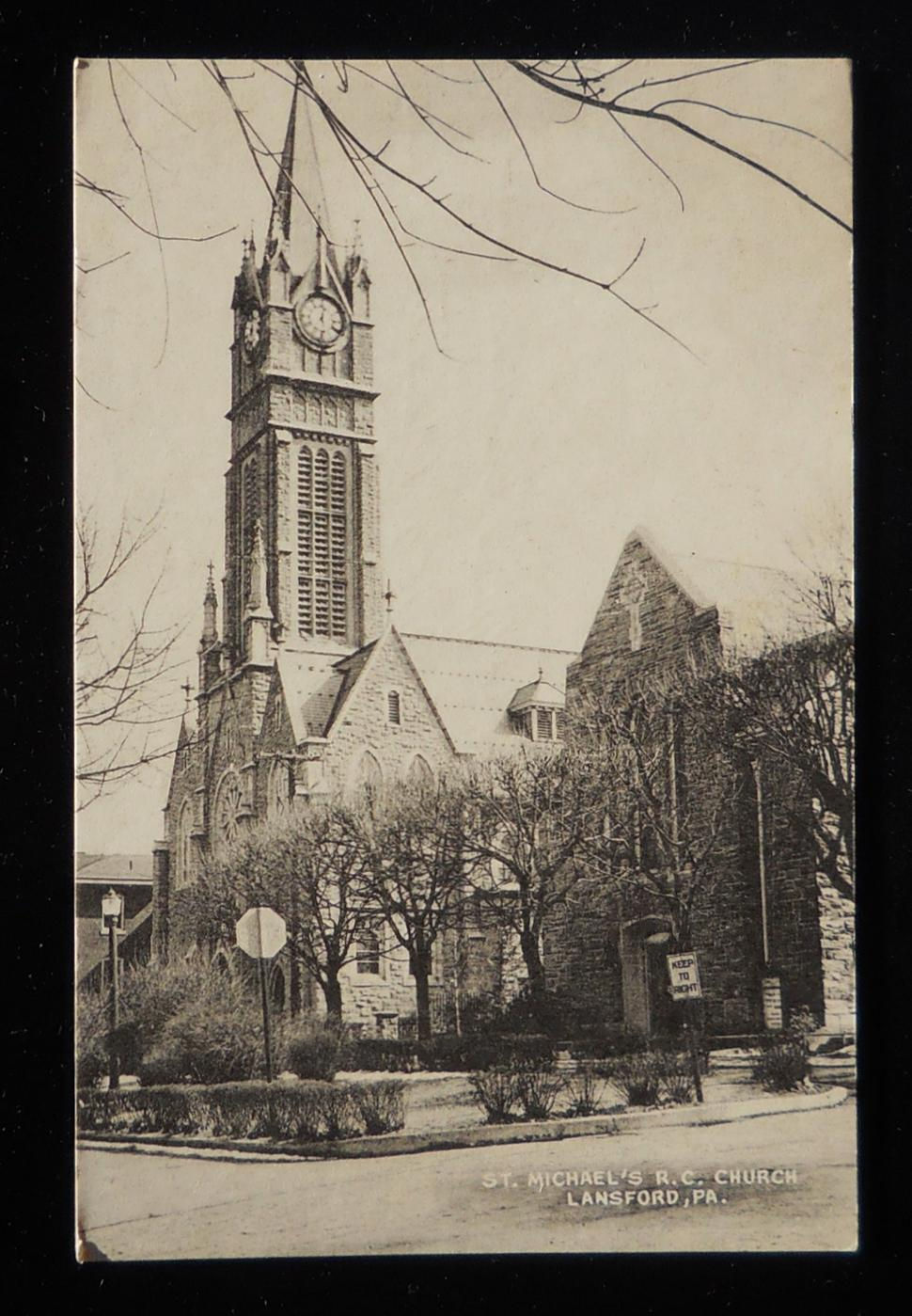
The deep-rooted sense of Slovak identity was also sustained through the community centered around Saint Michael the Archangel Slovak Roman Catholic Church in Lansford, Pennsylvania. Founded in 1891, the church no longer serves its original purpose today, but in its time it was a cornerstone of Slovak culture and civic life. A parish school, serving grades one through eight, was attached to the church, and we attended it. Mass was celebrated in Slovak twice a week, and hymns were often sung in Slovak, especially around the feasts of Our Lady of Sorrows.
Growing up, I remember that the later morning Mass on Christmas Day was celebrated solemnly, with incense and Slovak hymns that I can still recall—such as Čas radosti and Pospešte sem, pastuškovia. These hymns were central to who we were and were not reserved only for the church. I remember my mother asking me to sing for my grandfather when he was home sick with cancer and could not go to Mass.
(source: Courtesy, Matthew-Peter Butrie)
Palms were woven into intricate designs for Palm Sunday, a custom my maternal grandfather practiced faithfully. These special palms adorned the holy pictures in our home. As a very young child, I remember my father bringing me to the coal furnace to burn some of the blessed palms during violent thunderstorms.
The highlight of Easter was the Resurrection procession at the conclusion of the Vigil Mass, accompanied by the singing of Pán Ježiš Kristus vstal z mŕtvych. Such glorious singing! Traditional Slovak foods filled my mother’s wicker basket, which was covered with an embroidered cloth from my grandmother. One could see the Slovak words stitched into it as the food was carried to church to be blessed. I also remember the custom of splashing water on Easter Monday (men sprinkling women) and on Easter Tuesday (women sprinkling men).
I used to be an altar boy and loved all the special celebrations, the singing, and the sense of community. I also took part as the groom in Slovak wedding re-enactments at local festivals. Many people from the church came dressed in kroj to dance and sing traditional wedding songs, wanting to keep the culture and customs of their ancestors alive. One of the most memorable moments was trying to break through the circle of people—who held on tightly!—to steal back my “bride”.
But the parish my mother and I grew up in was home not only to Slovaks but also to Croats and Slovenes, and the saints of their homelands were reflected in the church itself. Its stained-glass windows portrayed Saints Cyril and Methodius, patrons of the Slavs; Saint Stephen, king of Hungary; and Saint Elisabeth of Hungary, whose cathedral is the jewel of Košice. Our church stood as a testimony to the multiethnic Austro-Hungarian Empire from which its parishioners had come.
The heart and soul of that fledgling parish were Monsignor William Heinen and the Missionary Sisters of the Sacred Heart. Monsignor Heinen, born in Germany, was unofficially known as the “Apostle to Slovak Catholics” in the United States, for he founded many Slovak ethnic parishes—including Saint Michael the Archangel Slovak Roman Catholic Church in Lansford. When he died in 1910, nearly two hundred priests attended his funeral to pay their respects to this extraordinary man.

(source: Courtesy, Matthew-Peter Butrie)
Through his efforts, the parish school in Lansford was staffed by the Missionary Sisters of the Sacred Heart—pioneering women who imparted both faith and knowledge to the children of Slovak immigrants. Seeing so many children in the parish, Monsignor Heinen appealed to the sisters in Germany. The mother superior hesitated. How, she wondered, could the sisters go to a far-off country and teach children who spoke Slovak, not German? She was persuaded when Monsignor Heinen pointed to a painting of the sisters who had been martyred in Papua New Guinea while spreading the faith. He reminded her that the sisters in Lansford would not face martyrdom—and that, by God’s grace, the language barrier would be overcome. And so it was.
My sister and brothers fondly remember Sister Maria Methodia (born Anna Soltiš in Prešov), who came to Lansford in 1913. She taught there for 59 years, educating three generations of children, including my grandmother, my mother Margaret, and my sister and brothers. A friend once told me that when Sister Methodia prayed the rosary, she did so in five languages: Latin—the language of the Roman Catholic Church; Slovak—her native tongue; German—the language of her religious congregation; Hungarian—the language spoken in the Kingdom of Hungary from which she came; and English—the language of her new country.
Sister Methodia taught each class to sing and dance the beloved Tancuj, tancuj, and she also composed a short Christmas recitation in Slovak and English to make school both easier and more joyful for the children. My mother remembered that recitation all her life, and it is included in this story for you to try yourself.
We were a close-knit family, and when I went to college, I began calling my parents every Christmas to read the recitation in Slovak so they could record it on their answering machine. We always ended those calls with singing. The last time I did so was on December 25, 2019. Unbeknownst to any of us, it was two days before my father’s passing and four days before my mother’s. May perpetual light shine upon them.
In 1960, Sister Methodia established a shrine to the Sacred Heart of Jesus in the coal mine in Lansford, which still stands today within the mine—now a museum. From that day forward, there were no accidents in the mine.
In 1998, a friend invited me to visit Slovakia and Carpathian Ruthenia with him. It was such a joy to see the land of my ancestors, the people, and the beautiful cities of Košice and Prešov. When I learned about the Slovak Living Abroad Certificate, I applied for and received it in 2010 together with my children. I hope to gain Slovak citizenship as well if the government removes the residency requirement, which currently makes it difficult to honor my ancestral legacy fully.

(source: Courtesy, Matthew-Peter Butrie)
This story has been a brief glimpse into the lives of some of my Slovak ancestors—a necessary retelling of the past. Yet it is not a dead past; rather, they have handed down a living tradition that we continue to embody. For me, one of the most tangible ways this tradition endures is through the food we share as a family. We connect around the table when we sit down together, break bread, and tell stories. There is something profoundly human about this—it is how God created us. Our Lord gives Himself to us as food at the table of the Eucharist. When we offer the bread and wine in remembrance of Him, He becomes a gift to us.
When I prepare certain family recipes, I feel united not only with the family and friends who share that meal, but also with the family members who have gone before me—those I knew and those I never met. Food is more than sustenance; it nourishes the spirit as well. Each meal is an act of gratitude—to God for the gifts of food, faith, and family. Those I know. Those I knew. And those I never knew. All are alive in Him.
Whatever happens, I will always cherish—and continue to cherish—sharing the land of my predecessors with my wife and children.
Poplánok with cheese
Dough:
½ packet dry yeast
¼ cup lukewarm water
1 tbsp sugar
2½ cups flour
¾ tsp salt
4 TBSP unsalted butter
½ TBSP shortening
½ cup milk, scalded and cooled to lukewarm
1 egg
Cheese topping:
1 lb. sharp cheese, grated
4 tbsp unsalted butter, at room temperature
2 eggs, beaten
½ cup milk
1 tbsp cornstarch
For the dough, dissolve the yeast in the lukewarm water, together with 1 tbsp sugar. Let proof until yeast forms bubbles.
Combine the yeast mixture with the other dough ingredients, and work until a smooth dough forms.
Let the dough rise in a pot until it doubles in size. Meanwhile, prepare the topping.
For the topping, combine the cheese topping ingredients in a blender or a food processor.
Grease a pizza pan or another large pan.
Preheat the oven to 350°F (180°C ).
On a floured board, roll out the dough to fit the pan.
Place the dough in the pan and prick it with a fork in several places, to prevent bubbles during baking.
Spread the cheese mixture on top.
Bake 30-45 minutes, or until browned.


Comments