The education Americans are overlooking — in Europe
After growing up in North America, I returned to Europe and discovered world-class universities at a fraction of the cost.

For many Slovak descendants growing up abroad, Europe begins as an idea rather than a lived reality.
It exists in family stories, in the names of villages our grandparents once spoke about, and in fragments of culture that traveled across the Atlantic generations ago. Yet for many in the diaspora, the continent itself can feel distant — both geographically and emotionally.
My own relationship with Europe followed a similar path.
I was born in Slovakia, but from a very young age I grew up in North America, navigating multiple cultures and identities. Like many Slovak descendants raised outside the country, I spent years building my life elsewhere. After completing high school in Vancouver — largely in French thanks to Canada’s bilingual immersion education system — I left British Columbia to explore the United States.
I attended Southern Illinois University on an NCAA Division I tennis scholarship, and my academic and professional path (and destiny) initially seemed firmly rooted in America.

Zuzana Palovic completed her bachelor’s degree at Southern Illinois University before crossing the Atlantic to pursue further studies in Europe. (source: Global Slovakia)
But something shifted during a summer visit back to Slovakia to see my grandparents — the same summer that Slovakia won its first and only World Championship in ice hockey. During that 2002 visit, I decided to reclaim something I had long overlooked: my Slovak citizenship.
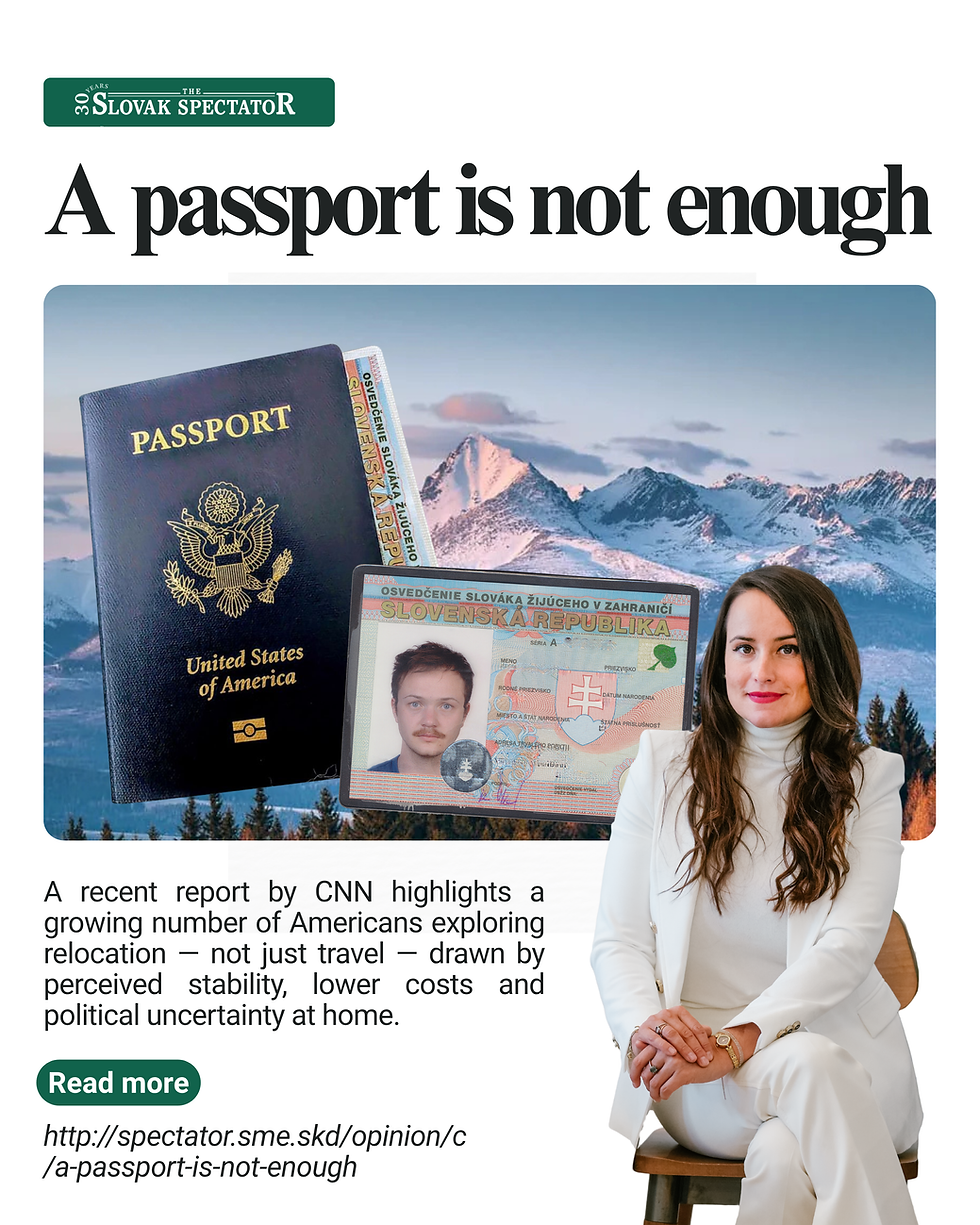
When the time came and I finally held my Slovak passport in my hands, it felt like far more than a legal document. It was a bridge back to the country of my birth — almost like a reinstated umbilical cord connecting me once again to the land and culture I had come from.
Not long after, Slovakia joined the European Union in 2004, and with that came a host of new and unexpected opportunities. As a Slovak citizen, I suddenly had the right to move freely across the European Union — to travel, live, and work in any of the member states.
What began as travel soon evolved into something much more transformative: a pathway to education.
After completing my bachelor’s degree in the United States, I decided to pursue a Master of Science in Europe. I was accepted to the University of Amsterdam — one of Europe’s leading universities — and moved to a city I had never imagined I would one day call home.
Amsterdam changed everything.
For more than two years, the city became my academic, professional, and personal base. My classmates came from across Europe and beyond, and classroom discussions were shaped by perspectives from different cultures, disciplines, and countries.
Living in Amsterdam was also an education in itself. The canals and historic streets carry centuries of intellectual and cultural history, yet the city remains dynamic, innovative, and forward-looking.
The academic experience was equally remarkable.
My professors included scholars who had taught at some of the world’s leading institutions — from the Sorbonne in Paris to the University of Chicago in the United States. My thesis supervisor was a professor from Harvard. The intellectual rigor was undeniable.

Zuzana Palovic graduating from the University of Amsterdam with a Master of Science (cum laude). (source: Global Slovakia)
And yet there was another realization that struck me during those years — one that many families in North America are only beginning to understand.
Studying in Europe also offers a very different model of higher education.
At a time when tuition at many American universities can exceed $60,000 per year and students frequently graduate with astronomical debt, European universities frequently offer world-class degrees for a fraction of that cost. For students who hold European Union citizenship, tuition fees in many countries are comparable to what local students pay.
My academic journey later continued in the United Kingdom, where I completed my PhD at the University of Surrey, when the UK was still a part of the European Union. The scholarship I received was made possible because I was an EU citizen and, in the eyes of the law, I had the same status and rights as British students.
Looking back, returning to Europe after my bachelor’s degree was one of the most consequential decisions I ever made.
It opened doors academically, professionally, and personally. But it also revealed something: Europe offers extraordinary educational opportunities that are often overlooked across the Atlantic.
Across the continent, universities offer English-language programs in fields ranging from business and engineering to social sciences and international relations. Students gain access to institutions with centuries-old academic traditions while living in cities that have served as global cultural and intellectual hubs for centuries.
In conversations with Slovak descendants around the world, I increasingly see families beginning to recognize this not just as an opportunity, but as a path forward. Slovak citizenship is a gateway — to mobility, global experience, and education.
In many ways, the migration story has come full circle. More than a century ago, Slovaks left the heart of Europe seeking opportunity in the New World. Today, their descendants are rediscovering Europe — not as a place their ancestors left behind, but as a continent that can once again offer opportunity for the next generation.
For me, returning to Europe for my studies reshaped the trajectory of my life. What began as a personal journey back to Europe ultimately reshaped the course of my life — from living in Amsterdam to studying and working in London, to ultimately returning to Slovakia and building a career that bridges Europe and the global Slovak diaspora.
For many Slovak descendants today, that same path may begin with something surprisingly simple: a Slovak passport.


Comments